


Professional Diploma in UX Design
If you occasionally wonder what leads a customer to take action, the Professional Diploma in UX Design is a perfect opportunity for you to better understand user behaviour and learn how to escalate the growth of any type of business.







Next start
10th November 2026
40 hours (20 Lessons of 2 Hours)
Schedule
Tuesday & Thursday, 6.00PM till 8.00PM
Price
€1,995
or from €257/month
Funding available
Format
Part-time, Online Live
- See start dates
Course overview
As products become more digital, there is an increasing need for skills to design smart digital interactions.
This practical, global certification considered to be the gold standard in UX education, will give you the opportunity to learn user research, design patterns & principles, workflows, interactions, mobile UX, structure and navigation, prototyping and wire-framing, analysis techniques amongst other vital skills whilst building a portfolio through a series of real-world projects using latest UX and collaborative tools like Figma & Sketch.



Credit-rated qualification
Credit-rated by Glasgow Caledonian University at SCQF Level 8, equivalent to EQF/MQF Level 5.

Gold standard in UX education
A practical, global certification considered to be the gold standard in UX education.
Build a real-world portfolio
Build a portfolio through a series of real-world projects using Figma & Sketch.
Who is this course for?
Entry requirements
Good Knowledge of English Online classes: Mac or Windows PC, WebCam, Stable Internet Connection
Validated by industry leaders
Our graduates work at companies across Malta and beyond.
- mita
- SiGMA
- Betsson Group
- MeDirect
- Tipico
- PwC
- Casumo
- HILI Company
- 9H Digital
- Deloitte
- APS Bank
- Evolution
- GO
- LeoVegas
- FIAU
- Lo & Behold
- Bank of Valletta
- Microsoft
- Audi
- Booking.com
- Methode Electronics








In depth curriculum
A module-by-module look at what you will cover in the Professional Diploma in UX Design, across 11 modules.
11 modules
Module 1
Introduction to UX Design will give you a strong understanding of user-centred design and the mindset required to create high quality software products. You’ll learn how this mindset differs from the traditional software development approach. And you will develop a clear understanding of the user-experience design process, the steps in the process, the importance of each step, and how they build on each other as the process unfolds.
You’ll recognise that UX Design is a problem-solving discipline focused on building technology products that will solve problems for end-users. You’ll know that the term ‘experience’ refers to the emotions of the end-users, and what differentiates great products is that they will create positive emotions for the end-users while they are solving their problems.
You’ll become aware of the risks of traditional software development and its pitfalls, and why and how UX design can mitigate these risks with a different approach. You’ll learn that UX is a research-based discipline, whereby design teams make decisions based on research conducted with end-users, and the insights gained from that research.
Topics covered include:
- User experience
- Functional design
- Product integrity
- Product desirability
- UX design process
- Process benefits
- UX and Agile process
- User interface design
- Humans v. machines
- Feature overload
- Shortcuts
- Prototyping
- Prioritisation
- Goals, behaviours, context
- Paradox of specificity
- Mental models
Module 2
By the end of this module, you’ll understand the importance of research as the key ingredient underpinning UX Design. Research is vital to understand the problems we are attempting to solve for users.
You’ll learn about the range of different types of research, such as qualitative v. quantitative, attitudinal v. behavioural. You’ll also learn how to prepare and carry out a variety of research techniques. The module will also teach you how to set clear usability test objectives, recruit users, prepare a test script, and facilitate and record usability test sessions for desktop and mobile.
You’ll also learn how to set clear objectives for customer and stakeholder interviews, to prepare scripts and to conduct and record interviews. You’ll also understand how to conduct card sorting exercises, online surveys, heuristic evaluations, as well as understanding the concept of A/B testing and how it helps optimise and refine existing software.
Topics covered include:
- Research landscape
- Qualitative research
- Quantitative research
- Observational / attitudinal
- Research bias
- Phrasing questions
- Usability testing
- Defining test objectives
- Test scripts
- Finding users
- Desktop / mobile setups
- Card sorting
- Depth interviews
- Online surveys
- Stakeholder interviews
- A/B testing
- Heuristics
- Heuristic rating scheme
Module 3
Through this module, you’ll understand the need to analyse the research data that you gather. It’s only through analysing this data that you can clearly articulate the problems that you’re attempting to solve for the end-user of your digital product.
You’ll become aware of the concept of triangulation - which is using multiple data sources as a way to provide a more accurate understanding of the problem to be solved. You’ll understand the full range of analysis techniques available to UX designers as they attempt to address design problems.
The module will also bring you through how to prepare and facilitate an affinity diagram session and understand the benefits of the outputs. You’ll also know how to prepare a customer journey map and understand its importance in capturing user goals. You’ll be introduced to the idea of design personas, you’ll understand the benefits of using them and you’ll learn how to prepare them. You’ll also be able to prepare a customer value curve and know the key benefits of using it in your design process.
Topics covered include:
- Triangulation
- Affinity diagrams
- Customer journey map
- Personas
- Customer value curve
- Empathy map
Module 4
During this module, you’ll learn how to design a coherent software product, based on clear structure and navigation. The starting point for software navigation is defining a clear structure and how this relates to navigation. You’ll understand the meaning of Information Architecture and how to define one.
You’ll also be introduced to the concept of flow and you’ll learn how to define a flow for a digital product. You’ll understand the concept of navigation and how it relates to Information Architecture and common desktop navigation patterns.
Topics covered include:
- Information architecture
- Flow
- Flow diagrams
- Screen states
- Navigation
- Global and local navigation
- Horizontal and vertical navigation
Module 5
You’ll learn how to design effective software screens and interactions during this module. You’ll start by learning the components of an interaction and how these components - such as control rules and feedback - facilitate an interaction. You’ll understand that feedback is the starting point for effective interaction design and will learn that wireframes are the design tool used to communicate controls, rules and feedback to developers.
Topics covered include:
- Interactions
- Micro-interactions
- Anatomy of an interaction
- Controls
- Rules
- Feedback
- Wireframes
- Sketching
Module 6
This module will enable you to harness the power of design principles when it comes to designing software products. You’ll understand that design principles are proven solutions to common problems across many different design principles including advertising, architecture and software design. You’ll understand how the design principles of perceivability and predictability help to make the purpose and function of a product clear.
You’ll also learn about affordances and how these can help communicate how a product works. You’ll also understand how adhering to conventions in design can increase usability - that the principles of constraints, feedback and forgiveness allow users to flow through software more effectively. This reduces effort and errors. And you’ll also be introduced to the powerful logic of Hick’s Law and Fitts’ Law.
Topics covered include:
- Affordances
- Conventions
- Feedback
- Constraints
- Forgiveness
- Hick’s Law
- Fitt’s Law
- Progressive disclosure
Module 7
By the end of this module, you’ll be able to use design patterns to enhance the quality of your software designs. You’ll learn that design patterns are techniques that allow you to bring design principles to life in software interfaces. You’ll be introduced to a range of concepts including chunking, alignment, table alignment, call-to-action, visual hierarchy and progress indicators, as a way to make software more perceivable and predictable.
You’ll recognise the different digital affordances and how they need to be harnessed appropriately in order to reduce errors, and the level of effort for users. You’ll also learn how help, error handling and inline validation can also reduce the level of effort, reduce errors and increase the smooth flow through software. You’ll also understand the concept of pattern libraries, an online resource that can help prevent designers from having to reinvent the wheel.
Topics covered include:
- Chunking
- Alignment
- Label alignment
- Call-to-action
- Visual hierarchy
- Progress indicators
- Digital affordances
- Pattern libraries
- Smart defaults
- Help
- Error handling
- Inline validation
Module 8
This module will guide you in how to design effective mobile applications. You’ll learn the different design considerations for designing desktop versus mobile products. You’ll understand the key differences between responsive websites, mobile websites and native applications.
You’ll also understand different mobile application types, based on the UXDI framework. You’ll also gain knowledge in mobile design patterns and how they are different from desktop design patterns.
Topics covered include:
- The mobile landscape
- Design considerations
- Responsive websites
- Mobile websites
- Native apps
- The rationale for apps
- App framework
- App types
- Unbundling
- Flows
- Mobile navigation
- Mobile navigation patterns
- Input types
- Content v. navigation
- Tap targets
- Notifications
- Displaying content
Module 9
By the end of this module, you’ll be able to define effective workflows, which allows users to complete common tasks. You’ll learn how to design effective registration and onboarding workflows which allow users to access products in a smooth fashion. You’ll also learn how to design effective sign-in processes for repeat users.
You’ll understand the concept of complex forms and how to design them effectively. You’ll also be introduced to the importance of payment flows and will learn techniques to allow you to increase the flow and the level of trust from users. You’ll also learn about micro tasks and the common components that you need in order to design them effectively. Finally, you’ll understand about the concept of mobile notifications and how to use them effectively.
Topics covered include:
- Registration
- Onboarding
- Onboarding styles
- Sign in
- Complex forms
- Structuring complex forms
- Minimising workload on forms
- Payment
- Payment flow
- Microtasks (or modes)
Module 10
The final module will equip you to build prototypes and compile wireframe documentation. You’ll understand the different types of prototypes and the benefits and drawbacks of each type, including high fidelity prototypes, medium fidelity prototypes and low fidelity prototypes.
You’ll also learn about the common prototype tools and how they can be used to develop the different types of prototypes. You’ll also understand the concept of wireframing, the common tools that you’ll use to create them and also how to create effective wireframe documentation.
Topics covered include:
- Why prototype?
- Choosing the right prototype
- Low fidelity prototypes
- Medium fidelity prototypes
- High fidelity prototypes
- Choosing the fidelity
- Paper prototyping
- Sketching
- Wireframing
- Wireframing tools
- Testing prototypes
Module 11
There are a total of 16 projects to guide you through researching, designing, and prototyping a website or mobile app. The early projects focus on research and analysis while the later projects focus on design. The projects are designed to give you hands-on experience and help you build a high-quality UX portfolio.
- Competitive benchmark
- Online survey
- Note-taking
- Usability test
- Affinity diagram
- Customer journey map
- Flow diagram for desktop or mobile
- Interaction design for desktop or mobile
- Prototype for desktop or mobile
- Usability test for a desktop or mobile prototype
- Wireframes for desktop or mobile
Request more details to view the full course syllabus, or book a call to speak with an education advisor.
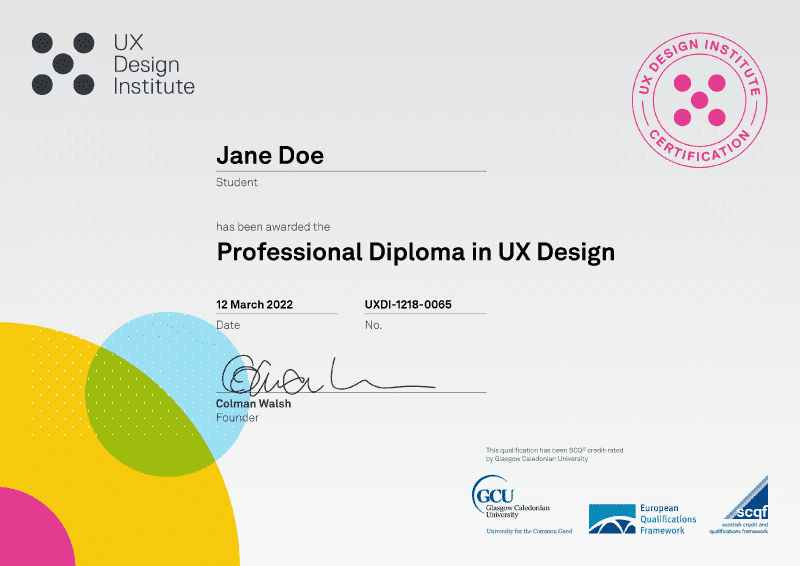
Your global certification
Upon completion of the 10 modules of the Professional Diploma in UX Design, all students are required to successfully complete 8 compulsory projects and one computer-based exam which will assess their knowledge of the course. The projects account for 60% of the overall assessment and the final exam makes up the remaining 40%. The certificate is awarded to students who achieve a total of 60% or higher overall. Once all compulsory projects are submitted, students can schedule their exam which can be hosted online from any space. The exam is two hours long. A range of different question item formats are used within the Professional Diploma in UX Design final exam as follows: Multiple Choice, Re-order, Matching, Scenario Based.
Learning experience
Every step of the way you receive support from your educator, your classmates and our dedicated student experience team. That is a promise.

Learning Platform
A courseware kingdom full of presentations, playbacks, quizzes & practice exercises accessible 24/7.

Taught by industry expert
Learn live with seasoned professionals in a unique, small-class environment.

Globally recognised certification
Worldwide recognised certifications by top tech brands which prove that you’re industry ready.

Student Experience Support
A helping hand before, during and after your learning journey.

Post-course educator support
Personalised feedback to help you achieve your goals for an additional 6 month window.

Practical learning
Hands-on exercises and real world projects to get you industry ready.
Pricing & funding. Simple, transparent.
Pay in one go or spread the cost, and check whether you can claim part of your fees back.
Get up to €1,396.50 refunded through the Get Qualified scheme.
Your cost could be as low as €598.50
Pay monthlyMost flexible
From
€257per month
No banks. No interest. Flexible monthly payments.
Get up to €1,396.50 refunded through the Get Qualified scheme.
Your cost could be as low as €598.50
More info on funding
Get your fees back
Two government schemes can refund part of the fee. The amount you get back depends on your situation, so these are the most you can receive.
Get QualifiedTax credit

- You pay
- €1,995
- Tax credit, up to
- €1,396.50
- Cost after tax credit, as low as
- €598.50
A 70% tax credit once you complete the course and gain your certification.
How Get Qualified worksMySkillsUp to 80% back

- You pay
- €1,995
- Refund if employed, up to 80%
- €1,596
- Cost after refund, as low as
- €399
- Refund if unemployed, up to 100%
- €1,995
Reimbursed by Jobsplus after you complete the course, up to €5,000. Not available to self-employed applicants.
How MySkills works
Convince your boss to sponsor your growth
Employers in Malta can recover part of the cost of training through the Investing in Skills (IIS) scheme.
What you’ll get
- Training by an Industry Expert & Certified UX Educator
- Official UXDI Courseware (Format: Digital)
- Official UXDI Project Reviews
- Official UXDI Practice Tests
- Official UXDI Exam
Starting dates
Our classes do not have an enrolment deadline, but demand is high and they fill up ahead of time because we purposely limit class sizes to keep every class personal.
- Enrol nowOnline livePart time€1,99580% Course Fees Back
10th November 2026
- Tue & Thu, 6.00PM till 8.00PM
- 40 hours (20 Lessons of 2 Hours)
Loved by students & brands
MatthewProfessional Diploma in UX Design ICE Malta never ceases to impress. Very professional school with extremely friendly and knowledgeable educators. Cannot praise the school enough.
JosephProfessional Diploma in UX Design ICE Malta has provided me with six life-changing courses. The learning experience is unparalleled, & I've used it to launch & grow multiple successful businesses.
DylanProfessional Diploma in UX Design This course might just be the key to unlocking exciting new opportunities within the industry. Highly recommended for those seeking fresh insights & prospects!
HristinaProfessional Diploma in UX Design When I came to ICE Malta, I wasn’t sure where to start in the tech world. I was afraid it would be hard to learn, but it turned out to be easier than I expected. I’m glad I made the right choice.
DijanaProfessional Diploma in UX Design Pleasantly surprised by what I learned in the UX course. The knowledge was delivered in an engaging way, using real-life examples that were easy to understand. The lessons were concise, making it easy to absorb important information.
KarenProfessional Diploma in UX Design The course was very well organized, the educator was always on time and well prepared. I liked that she gave us time to practice and provide us with feedback along the way. I highly recommend this course to anyone interested in the field - it is well paced and the small classes allow for a more personal environment where you can ask questions and learn from each other.
BlaineProfessional Diploma in UX Design Completing the UX diploma course was an incredible experience. Sasha, our trainer, was exceptionally knowledgeable and supportive throughout the program. Her practical insights and engaging teaching style made complex concepts easy to understand. I now feel confident in my UX skills and am excited to apply what I’ve learned in my career. Highly recommended!
GlennProfessional Diploma in UX Design The tutor is exceptional. She presented the lectures with clarity & precision. With her expertise, she transformed complex concepts into digestible insights, making the learning experience both enriching & enjoyable.
MartinaProfessional Diploma in UX Design Apart from being a well-informed and organized lecturer, Sasha's practical teaching style is very hands-on. She consistently supports us by answering all our questions and encourages every student.
MiraProfessional Diploma in UX Design The professional diploma in ux design has been incredibly valuable. The course content is well-structured, covering essential of principles in a practical and engaging way. I feel more confident in my UX skills and would recommend this course to anyone looking to deepen their understanding of user-centric design.
The Professional Diploma in UX Design is credit-rated by Glasgow Caledonian University (GCU) aligned to the Scottish Credit & Qualification Framework (SCQF) at Level 8 with 30 Credits. This is equivalent to EQF/MQF Level 5 with 15 ECTS. The pass rate is 89%.
You might also like
All courses







Frequently asked questions
Everything you need to know about the Professional Diploma in UX Design. Can’t find your answer? Speak to an advisor.
Yes. Thanks to ICE Malta’s Easy Payment Scheme, you can design an interest-free monthly payment plan to cover your tuition. No banks involved.
Students completing the Professional Diploma in UX Design can apply for the Get Qualified Scheme, a tax credit of 70% of the costs incurred (€1,396.50 will be refunded back for this course).
For the online classes: Mac or Windows PC, WebCam, Stable Internet Connection. In the ideal scenario students should have a computer setup with two screens, one where you can follow the lesson from (which can even be your mobile) and your main screen which you will use for practical learning. This will guarantee that your learning experience is really powerful.
Yes, we accept international students. However, some courses are license-restricted to residents of the Maltese Islands. Most of our courses are delivered online live, but if you wish to enroll in an on-campus course, you are responsible for obtaining a Student Visa.
The collection of MySuccess study programmes together with Google, Adobe, Cisco, Microsoft, LPI, Autodesk, IAPP & Digital Marketing Institute certifications are worldwide recognised certifications.
Meet with an expert
Not sure this is the right course? Book a free call with an education advisor.
Professional Diploma in UX Design
Next start 10 Nov 2026 · €1,995